Note: This is an edited version of an article published earlier on fundsupermart.com.hk on 10 Jan 20.
Highlights:
- Contracted sales for the first eleven months of 2019 grew about 20%, and property management is becoming an increasingly important revenue contributor.
- The overall credit profile is good, but the difficulty of refinancing is relatively high.
- The investment value of its mid- to long-term bonds is decent, with the YTM of the bond due July 2022 at 10.7%.
When first hearing of Fantasia Holdings Group Co., Ltd ("Fantasia"), many investors find it hard to associate the company with property development due to its whimsical (Chinese) name. In fact, besides a charming name, the company also offers attractive investment value in its USD bonds.
Background
Founded in 1998, Fantasia was listed on the HKEX in 2009 with the stock code 1777.HK. The company’s market capitalization reached HKD 8.71 billion at the market close on 8 January.
Property development and property management primarily constitute Fantasia’s core businesses. In terms of property development, the company mainly focuses on tier-one and tier-two cities in China, including Shenzhen, Chengdu, Beijing, Shanghai and Wuhan. Fantasia’s reported contracted sales amount in the first eleven months of 2019 was close to RMB 30.51 billion. Ranking 72nd among Chinese property developers, we can look at the company as a tier-three or relatively small Chinese property developer.
Another of Fantasia’s core business, property management, is operated by its subsidiary Color Life Services Group Co., Limited (“Color Life”). In 2014, Color Life was listed on the HKEX and became the first listed “social community service company”. Since then, the company's business has spread to over 200 cities in China with an aggregate managed area of more than 564 million square meters, which ranks number one in the industry.
Recent highlights
Stable growth in contracted sales
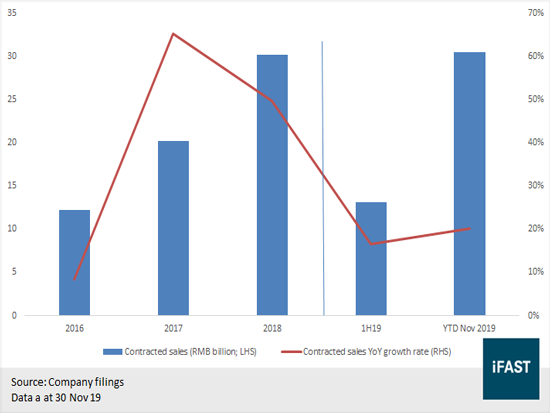
Amid the sluggish property market and the government’s increasingly restrictive funding policies for developers, Fantasia delivered decent results last year, even though contracted sales couldn’t match up to the rapid growth in previous years. Contracted sales jumped 20.1% YoY to RMB 30.51 billion in the first eleven months of 2019 (see Chart 1). Notably, the contracted sales performance was significantly better in the second half of 2019, as compared to the first six months.
Chart 1: Contracted sales
During the briefing for its 2019 interim results, Fantasia mentioned that the company’s upcoming business priority would be urban renewal projects. As at 30 Jun 19, Fantasia participated in 39 urban renewal projects in Shenzhen, Guangzhou, Foshan, Dongguan, Zhongshan and Huizhou, with a total estimated value of more than RMB 350 billion. Projects in Shenzhen accounted for nearly 50% of the total estimated value. With a total estimated construction area that exceeded 16 million square meters, Fantasia’s urban renewal projects provide it ample land reserves that should suffice its land requirements for the next few years.
Considering that the Chinese government is in the midst of developing the Guangdong-Hong Kong-Macao Greater Bay Area, and Shenzhen as its “pilot demonstration area", there is likely to be a massive population inflow into the Greater Bay Area, especially Shenzhen. That would naturally boost the local property market and, by extension, Fantasia’s business.
On the other hand, looking at the company’s track record, Fantasia has been rather conservative in doing business. Although Fantasia holds a lot of urban renewal projects, we expect the company to take a measured approach in converting its saleable resources to sales. As stated by the management in their interim results briefing, the company’s funds and resources are limited, thus its business expansion will not be at a breakneck pace. Even so, we believe that with the support of sufficient urban renewal projects, Fantasia should be able to maintain a stable growth rate in its annual contracted sales, and its long-term growth potential is decent.
Leading player in the property management sector
In the booming phase of the Chinese property market, although most property developers were involved in property management, it is typically regarded as a “good-to-have” side business. Compared with property development, the profitability of property management is relatively low and its contribution to Chinese developers’ revenue has been limited.
However, Fantasia took the opposite path.
Fantasia not only regards property management as its core business, but has also expanded the segment from pure property management to providing comprehensive community services, including community retail, community wealth management, community pension, as well as engineering services. As at 30 Jun 19, Color Life, Fantasia’s subsidiary in charge of the property management business, had 32 million registered users and a managed area of 564 million square meters.
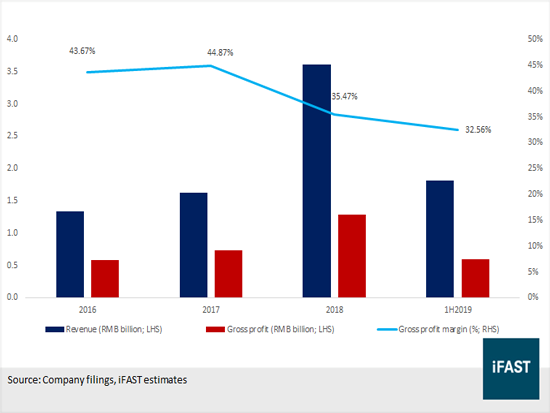
Color Life’s revenue has been growing in the past few years (see Chart 2), with eye-catching growth in 2018. In 1H19, Color Life recorded a revenue of RMB 1.81 billion, up 3.1% YoY, and gross profit amounted to RMB 620 million. It is worth noting that the gross profit margin of Color Life is relatively high with an average of 39.15% from 2016 to 1H19.
Chart 2: Revenue and gross profit margin of Color Life
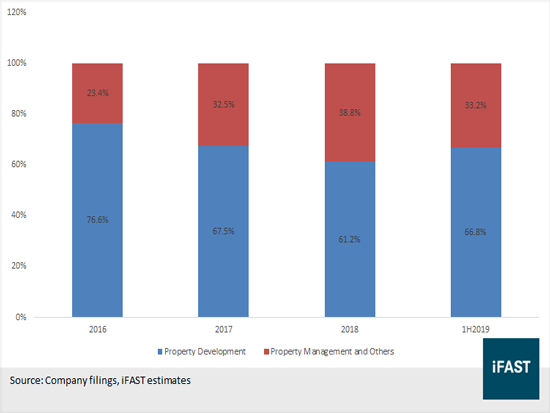
From the chart below, we also notice that except for 1H19, the revenue proportion of property management had been on the rise, and accounted for almost 40% of total revenue in 2018.
Chart 3: Revenue Breakdown
Nowadays, the Chinese property market is no longer as prosperous as before and the overall sales growth has declined sharply from the industry’s heydays. Against this backdrop, developers are starting to realize the importance of the property management business. This segment could provide stable cash flows and recurring revenue that are protected from the volatility in the residential market.
The property management business is especially beneficial in the current tightening credit environment for developers, in terms of expanding the funding channels of property firms, such as raising capital through spin-offs or securitization of receivables from the property management division. We noticed that other developers have been adopting this model after Color Life's spin-off listing. From Table 1, we can see that Color Life is the first property management company spun off among the Chinese developers, and it sports the largest managed area.
Also, the community service model adopted by Color Life is increasingly being followed by other developers. Overall, we consider Color Life as a tier-one player with industry-leading advantages in the property management sector. We foresee that as Fantasia grows its contracted sales area, revenue from the property management segment would continue to climb and likely contribute over 40% of total revenue.
Table 1: Operating performance of Studio City
| Company | Sponsor(s) | Date of listing | Managed Area (Million Square Meters) | 1H19 Revenue (RMB Billion) |
|---|---|---|---|---|
| Color Life | Fantasia | Jun 2014 | 564* | 1.81 |
| China Oversea Property | China Oversea | Oct 2015 | 142 | 2.16 |
| Greentown Services Group | Greentown | Jul 2016 | 184 | 3.66 |
| Agilelving | Agile, Greenland | Feb 2018 | 210 | 2.24 |
| Country Garden Services | Country Garden | Jun 2018 | 217 | 3.52 |
| Xinchengyue Holding | Seazen | Nov 2018 | 44 | 0.50 |
| Source: Company filings, data as at 30 Jun 19 *Includes area under consultancy service arrangements. |
||||
Credit Profile
Sound financials with low leverage
As at 30 Jun 19, Fantasia reported total short-term debt of RMB 11.21 billion and long-term debt of RMB 29.33 billion. Concurrently, cash and cash equivalents reached RMB 23.73 billion, which more than covered the company’s short-term financial obligations. Consequently, Fantasia faces little pressure from short-term debt repayment.
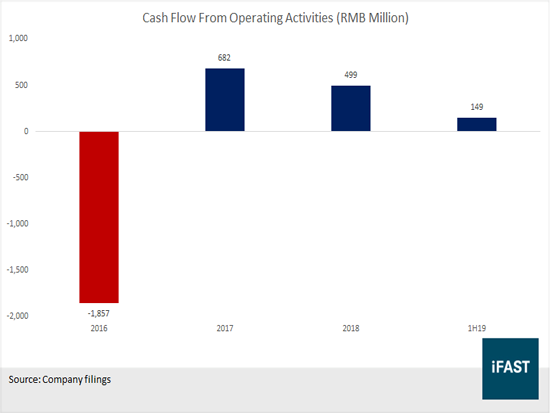
Fantasia’s relatively conservative business strategy results in a stable credit profile. We observe that the company has been generating positive cash flows from operating activities since 2017 (see Chart 4), which is commendable for a small-sized property developer with single-B credit ratings.
Chart 4: Fantasia’s cash flow from operations
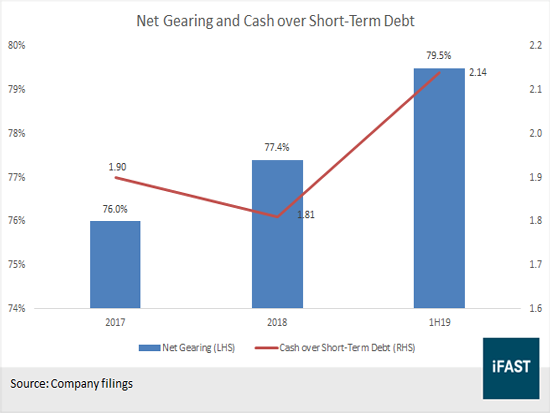
Besides that, we can see that Fantasia's net gearing ratios were 76.0%, 77.4%, and 79.5% at the end of 2017, 2018, and 1H19 respectively (see Chart 5). The company’s stable and below-average net gearing suggests that it has a good capacity to meet its financial obligations. Moreover, Fantasia has maintained a healthy cash-to-short-term debt ratio over the past two and a half years. This ratio reached 2.14x as of end-June 2019, which was higher than the company’s peers. For example, the cash-to-short-term debt ratios of Evergrande and Zhenro were 0.55x and 1.01x respectively. Overall, we think the credit profile of Fantasia is good.
Chart 5: Credit metrics of Fantasia
High financing costs
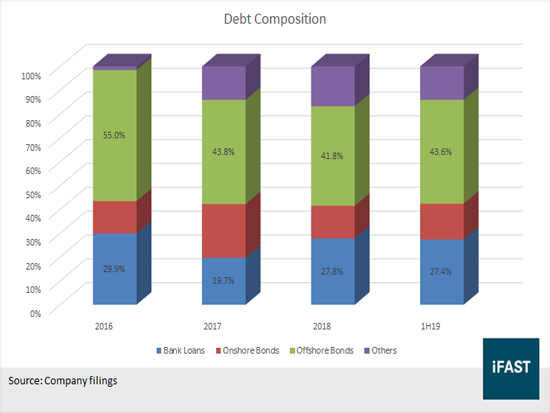
In 1H19, Fantasia's weighted average incremental borrowing rate was 10.31%, higher than most other Chinese developers. The reason behind Fantasia’s high borrowing cost is that the company relies heavily on the offshore bond market as its primary funding channel. From Chart 6, we can see that bank loans accounted for less than 30% of Fantasia’s total debt, while offshore USD bonds constituted close to half of its debt composition. The higher borrowing costs on USD bonds relative to domestic bank loans have pushed up Fantasia’s average borrowing rate.
Chart 6: Breakdown of Fantasia’s debt
Elevated funding costs will undoubtedly erode a company’s profit margins. The interest expense of Fantasia in 1H19 soared to RMB 1.515 billion, which was higher than the company’s profit before tax of RMB 1.262 billion. On the other hand, Fantasia is cognizant that sourcing for funding domestically is a challenge, and has always managed its debt amounts and leverage at a healthy level. Although this slows the company’s pace of growth, it is beneficial for its bond investors.
The Fantasia bonds are attractive
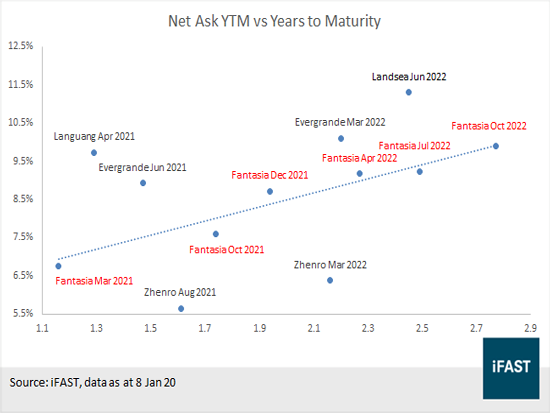
As at 30 Dec 19, there are seven bonds issued by Fantasia listed on our platforms, including six USD bonds and one CNH bond with investment horizons ranging from 0.7 to 2.8 years. Compiling the bonds issued by Fantasia and its peers with similar credit ratings (see Chart 7), we found that Fantasia’s short-term bonds are relatively unattractive. For example, the company’s notes due March 2021 are yielding 7.41%, about 200 bps lower than the bonds issued by Evergrande and Sichuan Languang Development.
On the other hand, the investment value of Fantasia's mid- to long-term bonds is higher, with a smaller yield differential against comparable notes of Evergrande and Languang. The Fantasia bond due April 2022 offers bondholders a YTM of 9.18%, nearly 100 bps lower than that of Evergrande's bond due March 2022. Considering that Fantasia has a better credit profile than Evergrande in terms of its leverage and cash ratios, we think the company’s mid- to long-term bonds are attractive investments.
It's worth mentioning that the Fantasia notes due April and October 2022 are trading at a premium above their face value, with ask prices of 104.72 and 105.20 respectively. Meanwhile, the Fantasia bond due July 2022 has an ask price of 96.90. Therefore, investors might want to give higher consideration to the July 2022 bond.
Chart 7: Relative valuation
Risk factors
Investors considering Fantasia’s bonds should pay attention to policy risk and foreign exchange risk. As mentioned earlier, the company is highly dependent on the offshore bond market and therefore highly sensitive to changes in exchange rates, as well as regulatory adjustments of offshore financing policies.
For instance, in July 2019, the exchange rate of US dollar against the RMB exceeded 7. At the same time, the National Development and Reform Commission tightened curbs on property firms issuing offshore US dollar bonds. Under the influence of these two factors, prices of Fantasia’s bonds had dropped significantly, with the bond due July 2022 falling to as low as 83. Therefore, we believe that even though Fantasia has sufficient cash at present, if the government tightens further financing rules for property developers, it may still face a liquidity crunch.
Declaration:
For specific disclosure, at the time of publication of this report, IFPL (via its connected and associated entities) has a principal position in EVERRE 8.250% 23Mar2022 Corp (USD) and EVERRE 7.500% 28Jun2023 Corp (USD). The analyst(s) who produced this report holds a NIL position in the abovementioned securities.